
Improving the Conditions Under Which RO Membranes Operate
The Integro™ is a commercially established electrochemical water-conditioning technology designed to prevent scaling and biofouling, protecting downstream RO membranes and keeping operations highly stable.
A Proven Technology. A New Application.
Established: Scale Control
2025: Cranfield Validation
2026: ITC Gran Canaria Trial
2026-2027: Active Field Development
Longer-duration proof-of-concept and larger-capacity trials currently operating.
Next: KTP Progress + Scale-up
Mechanistic understanding, optimisation and predictive engineering
The technical problem
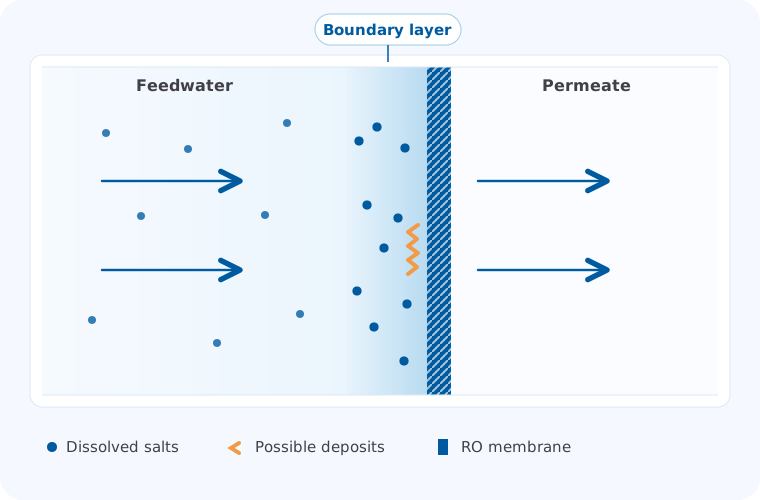
RO Performance Is Determined at the Membrane Interface
- Permeability deteriorates
- Flux becomes harder to maintain
- Pressure demand can increase
- Salt passage and conductivity may rise
- Scaling and fouling can progress
- Cleaning and energy demand can increase
Upstream Feedwater Conditioning, Not a Replacement for the Membrane
The Integro operates as an advanced scale-prevention and pre-treatment conditioning system. Installed directly in the upstream feedwater line, it alters physical water and ionic behaviour to help mitigate scaling, biofouling and mineral crystallisation. Testing also indicates measurable changes in ion passage across the membrane, with the potential to improve permeate water quality. By conditioning the feedwater before it reaches the reverse osmosis system, the Integro helps protect membrane performance, reduce scaling stress and support longer membrane life.

* exact configuration is application-specific
Three Independent Evidence Streams
The evidence base now spans independent academic research, live seawater operation and third-party high-recovery RO testing, providing complementary insight into how the technology behaves across different conditions.
Cranfield University
Bench-scale RO testing across synthetic freshwater, brackish water and seawater.
KEY METRICS
- Permeability, brackish +12.4%
- Flux-decline slope, brackish −41%
- Flux-decline slope, seawater −30%
Boundary: bench scale, synthetic water, short-duration testing.
ITC · Gran Canaria
Baseline compared with two configurations of the Integro in a live seawater RO skid.
KEY METRICS
- Normalised permeate conductivity −18.8%
- Rejection proxy 99.43%
- Best observed SEC −3.1%
Boundary: short campaign, relatively clean seawater
High-Recovery RO
Freshwater High-Recovery RO Comparison of untreated, full antiscalant and the Integro operating without antiscalant
KEY METRICS
- Scaling vs untreated ≈−50%
- Permeability retention Improved
- Permeate produced ≈96 m³
Boundary: freshwater evaluation; subsequent reduced-dose phases not completed.
Isolating the Effect Under Controlled Conditions
The Cranfield programme examined permeability, flux decline, ion passage, contact time and storage. The purpose was not to claim full-scale economics, but to test whether conditioned feedwater measurably changes membrane behaviour.
Permeability improvement (%)
Reduction in flux-decline slope (%)
Indicative ion passage ratios
| Ion | Control | El Integro |
|---|---|---|
| Ca | 0.170 | 0.119 |
| Cl | 0.143 | 0.032 |
| SO4 | 0.430 | 0.027 |
Contact-time effect
STAGE 2: ITC GRAN CANARIA
From the Laboratory to Live Seawater RO
Building on the controlled testing undertaken at Cranfield University, the ITC programme is evaluating Integro performance under live seawater reverse osmosis conditions. The trial is measuring membrane permeability, flux stability, ion passage, conductivity, pressure behaviour and scaling performance during live operation. This allows us to compare untreated and Integro-conditioned feedwater under real operating conditions and build the longer-duration evidence required for larger-scale deployment.
- Live seawater RO under real marine conditions
- Continuous operational and water-quality monitoring
- Direct comparison of baseline and Integro-conditioned feedwater
Normalised Performance Metrics
Métrico
Línea de base
389.5 µS/cm
316.3 µS/cm
317.3 µS/cm
Conductivity-based rejection proxy
99.25%
99.36%
99.43%
Specific Energy Consumption
2.13 kWh/m³
2.07 kWh/m³
2.11 kWh/m³
improvement in normalised permeate conductivity
improvement in specific energy consumption observed under the tested ITC configurations.
Can the Integro Carry Part of the Antiscalant Function?
High-Recovery RO – No Scale Control
Without effective scale control, high-recovery RO can create a severe calcium carbonate scaling risk at the membrane surface.
- Fouling risk: Extreme
- Acid CIP washes: Regular
Full
Antiscalant
Conventional antiscalant dosing can provide effective scale control, but introduces ongoing chemical cost, handling and discharge considerations.
- Scale protection: Complete
- Chemical handling: Perpetual
The Integro · No Antiscalant
Electrochemical feedwater conditioning reduces the tendency for hard, adherent scale to develop, allowing operation with substantially reduced or, under tested conditions, no antiscalant
- Reduced chemical dependency
- Potential OPEX reduction
What the Evidence Supports
The evidence to date shows that upstream electrochemical conditioning with the Integro can alter scale-forming behaviour and the conditions presented to an RO membrane. Across laboratory and field testing, this has been associated with reduced scaling, improved permeability and flux stability, and measurable changes in ion passage and permeate conductivity. The precise electrochemical and membrane-interface mechanisms remain part of our ongoing research programme.
Technical Boundaries
What We Know. And What We Are Still Working to Prove.
The evidence is encouraging, but the distinction between outcomes already demonstrated and the areas still being quantified is fundamental to the development programme.
Demonstrated to Date
- The Integro’s core scale-control application is commercially deployed
- Measurable permeability, flux-decline and ion-passage effects at Cranfield
- Effects observed across freshwater, brackish water and synthetic seawater
- Repeatable reduction in permeate conductivity under live SWRO conditions
- Productive flow maintained during selected ITC comparisons
- Directionally favourable SEC movement measured
- Independent freshwater high-recovery RO scale mitigation without antiscalant
Still Being Quantified
- Long-duration scaling and fouling suppression in real seawater
- Performance under harsher and more variable feedwater
- Long-term membrane-life impact
- Cleaning-frequency reduction
- Optimum configuration by water chemistry
- Safe antiscalant-dose reduction by application
- Recovery-rate optimisation
- Whole-life energy and OPEX value at commercial scale
- Complete electrochemical and membrane-interface mechanism
Academic Partnership: Heriot-Watt University
A 26-month Knowledge Transfer Partnership with Heriot-Watt University is bringing deeper electrochemical expertise into the business and helping convert laboratory and field evidence into repeatable engineering capability.
Data
Gathering water chemistry, membrane-performance and physical system data under controlled and field conditions.
Understanding
Heriot-Watt expertise will help analyse the electrochemical, mineral and membrane-interface behaviour observed across laboratory and field testing.
Optimisation & Deployment
Synthesising laboratory and field evidence into predictive tools to improve system selection, configuration and deployment.

How Sidon Works With Operators
Understand the plant
Feed chemistry, membrane type, recovery, pretreatment, age, duty and operational constraints.
Establish baseline
Pressure, flux, conductivity, SEC, chemical use, CIP frequency and membrane history.
Define intervention
Determine the optimum Integro location and treatment configuration within the existing plant, including the most appropriate point for retrofit or integration
Run controlled comparison
Minimise simultaneous changes and compare like with like using normalised data.
Optimise after stability
Only then evaluate changes to chemical dose, recovery, pressure or other operating parameters.
Technical Library
Cranfield University - Scaling Control in Reverse Osmosis
Independent bench-scale work across freshwater, brackish water and seawater.
ITC Gran Canaria - Improving SWRO Performance Through Upstream Conditioning
Technical paper based on live seawater RO testing.
Discuss Your RO or Desalination Application
Every RO system is different. Share your feedwater chemistry, operating data and treatment configuration with our technical team and we can assess where the Integro may fit within your process.
Frequently Asked Questions
Eficiencia de RO y desalinización
How should the business case for the Integro™ in RO be assessed?
Compare the capital and operating cost of the Integro™ with the full current pretreatment and operating cost: chemicals, antiscalant, membrane replacement, CIP, energy, downtime, waste, labour and any capacity or recovery constraints. Savings should be tied to measured plant data wherever possible.
What should be measured in an RO trial?
Typical KPIs include feed and permeate conductivity/TDS, ion passage or rejection, operating pressure, differential pressure, permeate flow, normalised flux/permeability, recovery, specific energy consumption, antiscalant dose, cleaning frequency, membrane replacement and overall lifecycle economics.
Does the Integro™ replace all conventional RO pretreatment?
No. Large RO and desalination plants may require screening, filtration, coagulation/flocculation, pH adjustment, dechlorination, softening, antiscalant or other processes for reasons beyond scale alone. The Integro™ should be assessed against the whole pretreatment train and the specific risks present.
Can the Integro™ improve recovery or reduce clean-in-place frequency?
Can the Integro™ improve recovery?
Potentially, where scaling limits the sustainable recovery of a system. Any increase in recovery must be validated against saturation indices, concentrate chemistry, membrane limits and long-term fouling behaviour.
Can the Integro™ reduce clean-in-place frequency?
Potentially. If scaling and fouling are reduced, cleaning intervals may lengthen. This is an important KPI for longer-term trials because it affects chemicals, labour, membrane life and plant availability.
Can the Integro™ reduce RO energy consumption?
Yes. As membrane permeability or resistance improves, the same output may be achieved with lower pressure or energy, depending on the plant. Short trials have shown encouraging results, but the commercial claim should be based on plant-specific normalised data rather than a universal saving.
Can the Integro™ replace a softener before RO?
In many cases it may allow a softener to be removed, but this is not a universal claim. A softener physically removes hardness ions; the Integro™ does not. Water chemistry, membrane design, recovery and the required permeate specification all need to be considered.
Can the Integro™ reduce antiscalant use?
Potentially, but any reduction should be controlled and validated. The safest approach is to establish baseline dosing and membrane performance, then progressively optimise antiscalant while monitoring scaling risk, permeate quality, pressure, recovery and clean-in-place frequency.
Can the Integro™ increase membrane life?
Potentially. If scaling and fouling are reduced, membrane cleaning frequency and replacement intervals may improve. The actual life extension should be demonstrated over time rather than assumed from a short trial.
Can the Integro™ reduce membrane scaling or fouling?
That is one of the principal objectives of upstream conditioning. Testing to date has shown encouraging reductions in flux decline and fouling/scaling indicators under specific conditions. Longer-term operational trials are important for determining the effect at full plant scale.
Can the Integro™ improve permeate quality?
Independent and development testing has shown improvements in permeate conductivity and selected ion passage under tested conditions. The magnitude depends on membrane type, feed chemistry, pressure, recovery and plant configuration, so project-specific validation is important.
Does the Integro™ remove salt or lower feed-water TDS before RO?
No. The Integro™ is not a desalination membrane and does not remove dissolved salts from the feed. Its potential value is in changing feed-water behaviour so that the downstream membrane process may operate more effectively.
What independent evidence is available for RO performance?
Independent work at Cranfield University evaluated Integro™ pretreatment across different water types and operating conditions. Sidon Water has also undertaken further seawater reverse-osmosis testing and field development. Results should be presented with the specific test conditions and should not be treated as a guaranteed percentage improvement for every plant.
Where should the Integro™ be installed on an RO or desalination plant?
A common position is on the RO feed upstream of the cartridge filtration and high-pressure pump, subject to the specific pretreatment train and plant design. The objective is to treat the water before it reaches the membrane system and other scale-sensitive components.
Can the Integro™ be installed before reverse osmosis?
Yes. Upstream electrochemical feed-water conditioning is an important application area for the Integro™. The purpose is to influence scale and fouling behaviour before the feed reaches the membranes.