
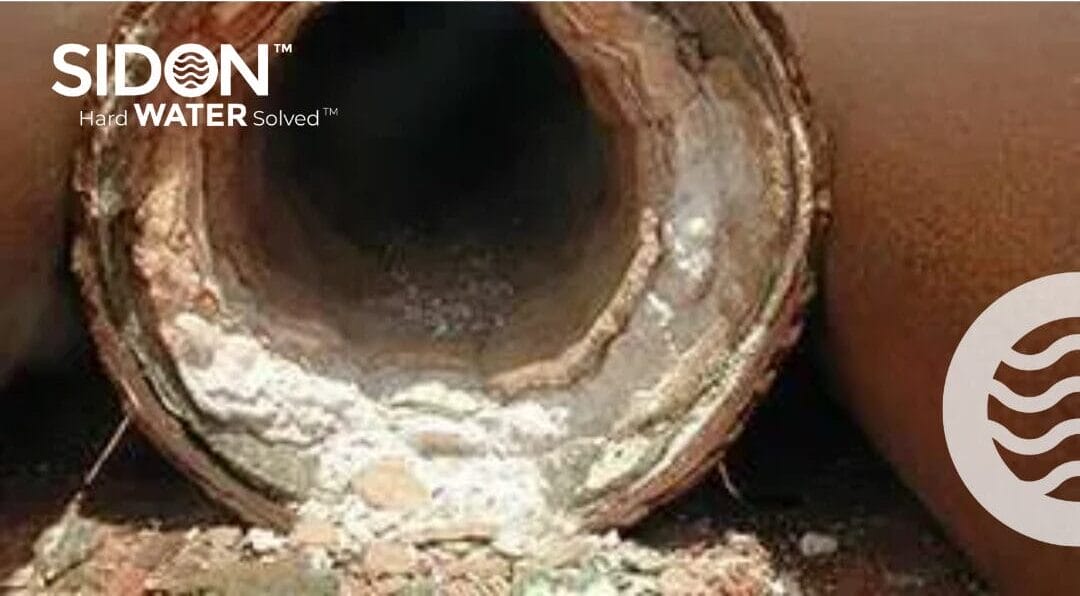
Oplossing voor het voorkomen en verwijderen van kalkaanslag
DeIntegroTM, chemievrije waterherstructurering.
Het meest effectieve waterherstructureringssysteem in de branche
Deze unieke technologie verwijdert bestaande kalkaanslag in watersystemen, apparatuur en toestellen en voorkomt toekomstige kalkaanslag. Onze oplossing is effectief ongeacht de waterhardheid, temperatuur en druk, omstandigheden waarin minder effectieve oplossingen falen.
In tegenstelling tot traditionele waterbehandelingsoplossingen die de kalkaanslagvormende ionen doen neerslaan, breekt deIntegroTMdeze ionen af en herstructureert ze, waardoor ze in hun neutrale vorm in de oplossing achterblijven. Meer informatie over het verschil tussen onze technologie en andere systemen (magneten, spoelen, katalytische uitwisseling, enz.) vindt uhier (Werkt waterbehandeling?).
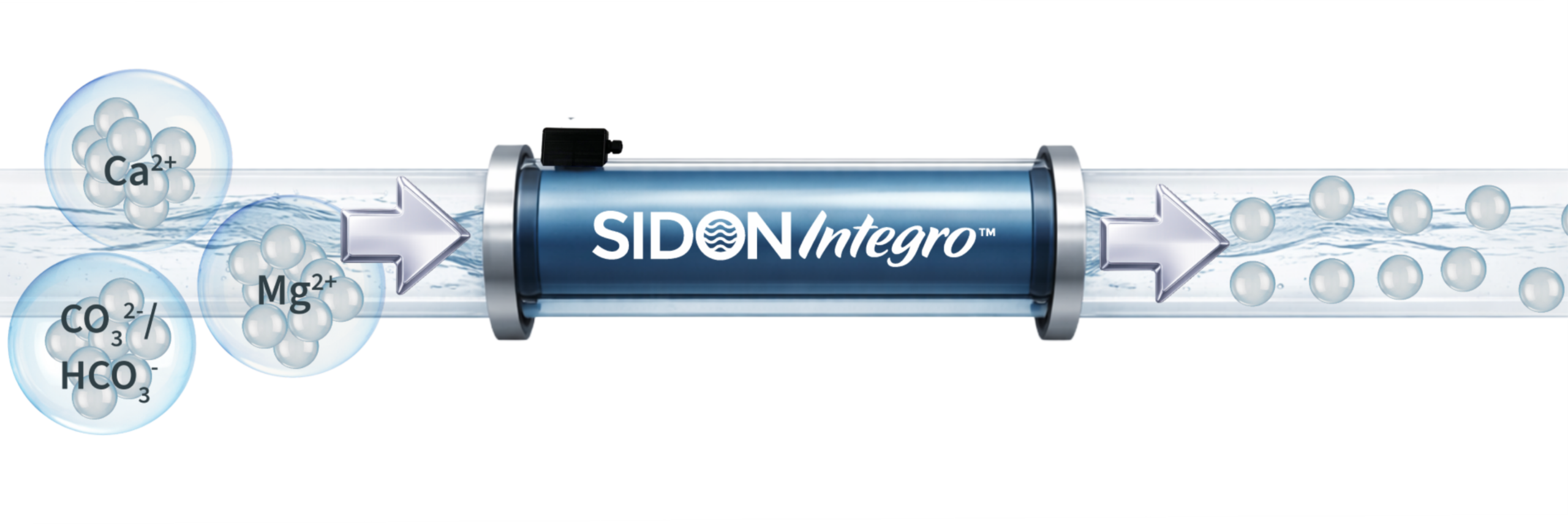
Hoe de Integro™ werkt
De Integro verandert de ionische activiteit in het water, waardoor de omstandigheden worden verstoord waarin calciumcarbonaat doorgaans harde, vastzittende kalkaanslag op oppervlakken vormt. Hierdoor blijven de hardheidsmineralen in het stromende water in suspensie, in plaats van dat ze zich als dichte afzettingen op apparatuur vastzetten.
- Oplosbare hardheidsmineralen en andere kalkaanslagvormende stoffen komen met het stromende water de Integro binnen.
- Terwijl het water door de Integro stroomt, veranderen de elektrochemische omstandigheden, waardoor het normale kalkaanslagproces wordt verstoord.
- Het resultaat is water waarin calciumcarbonaat minder snel harde, vastzittende kalkaanslag vormt op de oppervlakken van het systeem.
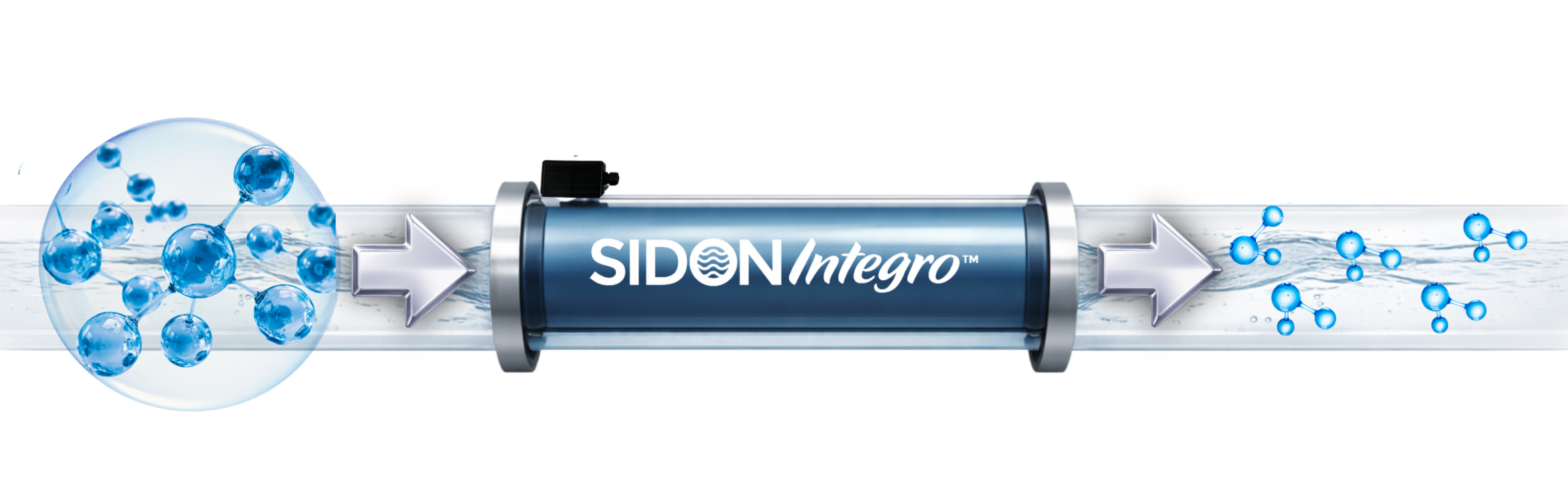
Ons Wetter-watereffect
Een ander voordeel van met Integro behandeld water is een verbeterde bevochtigingswerking. In de praktijk wordt dit vaak omschreven als ‘beter bevochtigend water’: water dat effectiever in contact komt met oppervlakken, filtermedia en membraanstructuren.
- Het water komt in zijn normale, geclusterde toestand de Integro binnen.
- Terwijl het water door de Integro stroomt, verandert het gedrag ervan op een manier die het contact en de doorstroming door het filtermedium kan verbeteren.
- Het resultaat kan ‘natter water’ zijn, dat wil zeggen water dat gemakkelijker door filtermedia en membranen stroomt, wat bijdraagt aan betere filtratie- en omgekeerde osmoseprestaties.
De Integro verbetert...
Met de Integro kunnen snel aanzienlijke en meetbare besparingen worden gerealiseerd. Kenmerken en voordelen van onze oplossing zijn onder meer:
Kalkaanslag voorkomen en verwijderen
Het Integro™-systeem voorkomt effectief nieuwe kalkaanslag en verwijdert het grootste deel van de bestaande kalkaanslag binnen 1-3 maanden.
Aanzienlijke vermindering van roest en corrosie
Door elektronen in het water te injecteren, helpt de Integro™ corrosie in uw systemen te verminderen, waardoor apparatuur wordt beschermd en de levensduur ervan wordt verlengd.
Verbeterde bacteriologische controle
Het systeem voorkomt de vorming van kalkaanslag en biofilm, waarin schadelijke bacteriën zoals legionella kunnen nestelen.
Verminderd energieverbruik
De Integro™ verbetert de warmteoverdracht met wel 40% door de verwarmingsoppervlakken schoon te houden.
Milieuvriendelijk
Deze technologie is vrij van chemicaliën en vereist geen periodiek onderhoud; ze zuivert het water op natuurlijke wijze zonder het milieu te schaden en zorgt voor een duurzame en kosteneffectieve waterzuivering.
Casestudy's over het voorkomen en verwijderen van kalkaanslag
Bekijk hier ons volledige aanbod aan casestudy’s




Frequently Asked Questions
Preventie en verwijdering van kalkaanslag
Can removing old scale reveal leaks or existing defects?
Yes. Old scale can sometimes mask degraded seals, pinholes, failing valves or other defects. When historic deposits reduce, underlying mechanical problems may become visible. This is a system-condition issue rather than a new defect created by the treatment.
Can released deposits block strainers, filters or heat exchangers?
It can. Historical deposits that begin to release may migrate to filters, strainers, small orifices, shower heads or heat-exchanger passages. Where a system is heavily scaled, Sidon Water recommends an appropriate commissioning and inspection plan so released material can be managed.
Can released scale appear as flakes, powder or grit?
Yes. As historic deposits become less stable, some systems may release fine white material, grit, flakes or other debris. This can be a normal transitional effect and should be considered when commissioning older or heavily scaled systems.
How long does existing scale take to come away?
There is no fixed period. The rate depends on deposit thickness and composition, water chemistry, temperature, flow, system design and how long the deposit has been present. Field experience ranges from relatively rapid visible changes to progressive improvement over several months.
Does the Integro™ remove existing limescale?
The Integro™ is intended both to reduce new hard scale formation and to support gradual removal and destabilisation of existing deposits. Existing scale should not be expected to disappear immediately or uniformly from every part of a system.
How quickly will I notice a difference?
That depends on what is being measured. Reduction in new scale formation may be observed relatively quickly at some outlets or heat-transfer surfaces, while the gradual removal or destabilisation of historic deposits can take weeks or months (usually 1-3 months). Large, heavily scaled systems may take longer.
Does the Integro™ prevent every type of scale or deposit?
Does the Integro™ prevent every type of scale or deposit?
No technology should be presented as preventing every deposit under every condition. The Integro™ has primarily been tested with mineral scaling, particularly calcium-carbonate-related scale. Significant benefits have been observed in systems where deposits involving silica, iron, manganese, process contamination, corrosion products or biological material are present, but further quantification of effectiveness is needed in these areas.
Are there water chemistries or chemicals that may be unsuitable?
Yes. Applications involving strong caustics, unusual chemical dosing, aggressive cleaning-in-place regimes or specialist process chemistry should be reviewed before specification. The Integro™ should not be assumed to be compatible with every chemical-treatment programme without assessment.
Does the Integro™ work in very hard water?
Does the Integro™ work in very hard water?
The Integro™ has been used in very hard-water applications, including borehole supplies, and handles varying hardness levels without manual intervention or adjustment.
Is there a maximum water hardness for the Integro™?
No universal maximum has yet been defined. Hardness is only one part of the picture. Alkalinity, pH, temperature, dissolved solids, flow, pressure, residence time, the type of scale being formed, and other chemicals present in the system can all matter.
Is the Integro™ a water softener, and does it remove hardness minerals?
Is the Integro™ a water softener?
No. A conventional ion-exchange softener removes calcium and magnesium ions and replaces them, typically with sodium. The Integro™ does not remove hardness minerals and therefore does not chemically soften the water. It is a scale-management technology rather than an ion-exchange softener.
Does the Integro™ remove calcium and magnesium from the water?
No. Calcium and magnesium remain in the water. The objective is to change the way scale-forming minerals behave so they are less likely to form hard, adherent deposits on heat-transfer surfaces, pipework, valves, outlets and other equipment.
Will a hardness test show that the Integro™ is working?
Usually not. Because the hardness minerals remain in the water, a conventional hardness test may show little or no change before and after the Integro™. Performance should be assessed against the actual operational problem being treated, such as scale accumulation, maintenance frequency, heat-transfer performance or membrane behaviour.
How does the Integro™ reduce hard, adherent limescale?
Wat is de Integro™?
The Integro™ is an inline electrochemical water-conditioning system designed primarily to reduce the formation of hard, adherent mineral scale and to help existing scale deposits gradually become less stable. It treats water without salt-based regeneration, routine chemical dosing or sacrificial treatment media.
How does the Integro™ work?
Water passes through a purpose-designed treatment chamber in which a controlled electrochemical effect influences the way scale-forming minerals behave and crystallise. Rather than removing calcium and magnesium from the water, the Integro™ is designed to shift mineral growth away from hard, adherent deposits on equipment surfaces and towards less troublesome forms within the flowing water.